Who holds the pen at the end of the story?
Advances in modern medicine can keep our bodies alive long after our minds have gone. But just because we can keep someone alive, does it mean we should? In this unit, we look at one of the hardest moral questions of our time: the right to die. You need to understand the legal facts, but also the emotional pain. If you were in this situation, what would you do?
- Euthanasia (noun): Helping a very sick person to die without pain.
- Suicide (noun): The act of intentionally killing yourself.
- Murder (noun): The illegal and intentional killing of a person.
- Manslaughter (noun): Killing someone illegally, but by accident.
1. Raw Vocabulary: The Ethics of Death
2. Idioms and Expressions in Crisis
When families talk about life and death, they often use idioms to explain the unthinkable.
- "To pull the plug." To turn off a life-support machine; to end something completely.
- "To play God." To make decisions about life or death that should belong to nature.
- "Quality of life." How good and comfortable a person's life is. A life filled with pain has poor quality.
- "On your last legs." Very close to dying or breaking down.
- "To put someone out of their misery." To kill someone to stop them from suffering any more.
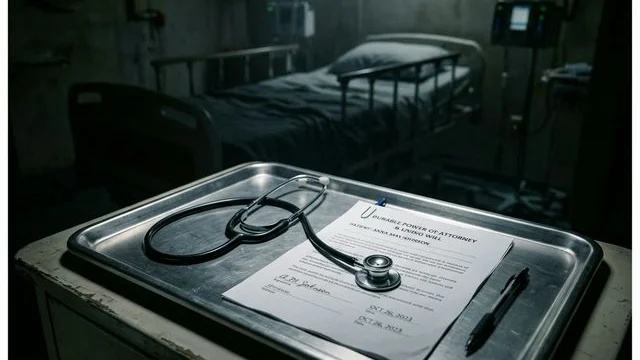
3. Reading: Mercy or Murder?
Read these three true stories that destroyed families.
Case 1: The Loving Son
Mike O'Brien had terminal cancer and suffered terrible pain. He told his family that he used to be a strong man, but now he was on his last legs. If his pain got too bad, he wanted to end his life. But when the time came, he was too weak to open his bottle of painkillers. His son, who loved him deeply, opened the bottle. Mike took the pills and died. Later, the son was arrested for helping with a suicide.
Case 2: The Broken Parents
Antonia James, 24, had a fatal car crash which caused permanent brain damage. She was in a coma and survived only on life-support. Her parents believed it would be kinder to let her die. They begged the doctor to pull the plug, but the doctor refused. He said that giving food through a tube is a basic human right, not just a medical treatment.
Case 3: The Secret Nurse
Alan Jones, 78, had a severe stroke. His brain damage was slowly killing him. His daughter secretly asked a nurse to end his suffering. The nurse turned off his oxygen until his heart stopped, then turned it back on so it looked like a natural death. If the daughter hadn't told a friend, no one would have known. The nurse was charged with murder.
4. Language Focus: Words of Life and Death
In English, we pair specific adjectives with 'death'.
Exercise A: Choose the Correct Word
1. He died a ___________ death after a long battle with terminal cancer.
2. After the terrible car crash, the police called it a ___________ death.
Exercise B: Complete the Expressions
Type the missing words to complete these heavy idioms.
1. The doctor refused to stop the feeding tube, arguing that he did not want to play with his patient's life.
2. The family made the painful decision to pull the on the life-support machine.
5. Debate Support: Prepare Your Arguments
Before you debate, look at these points and use the sentence starters below.
- People should have the right to control their own bodies.
- It stops unnecessary physical and emotional pain.
- It allows people to die with dignity, surrounded by family.
- Doctors must save lives, not end them (The Hippocratic Oath).
- There might be a "slippery slope" leading to non-voluntary killing.
- Some sick patients might feel pressured to die so they aren't a burden.
- "If I were in this situation, I would..." (Conditionals)
- "It is highly probable that..." (Modals of Probability)
- "The son who helped his father was..." (Relative Clauses)
- "Even though some argue that..., my opinion is..."
6. The Hot Seat: Debate Practice 🎙️
- In Case 1, do you believe the son committed a crime by opening the bottle? Should he go to prison?
- In Case 2, whose decision should it be? If the parents say her life is over, should the doctor be forced to listen?
- In Case 3, was the nurse acting out of mercy, or is this simple murder?
- Why is "Quality of Life" so hard to define legally?
- If euthanasia is made legal, how can we make sure old people aren't pressured into doing it?
Dominate the Discussion 🎙️
Don't just nod your head in conversations. Master the advanced phrasing to eloquently defend your opinions in high-level debates.
Come and join me for a bespoke English lesson at nativeuk.com designed specifically to build your conversational confidence.
Book a Private SessionMore Free Topics? 📰
Want to speak clearly about politics, tech, and the modern world? We've got the secret vocabulary you won't find in textbooks.
Check out our Good to Know section and dive into our Blog. You’ll be leading conversations like a native speaker in no time.
Explore Free Resources