Drawing the Line.
In an increasingly globalized world, the movement of people across borders sparks intense political warfare. Do wealthy nations have a moral obligation to accept those fleeing war and poverty? Or does a nation have the absolute right to protect its culture, economy, and security by closing its gates? In this unit, we explore the vocabulary of prejudice, integration, and survival.
- Xenophobia (noun): Dislike of or prejudice against people from other countries.
- Asylum (noun): The protection granted by a nation to someone who has left their native country as a political refugee.
- Assimilation (noun): The process of adapting or adjusting to the culture of a group or nation, sometimes at the cost of one's original cultural identity.
1. Raw Vocabulary: Policies and Prejudice
Practice: drag a word, or select it and choose a gap.
1. The government decided to use the immigrant population as a to distract from their own economic failures.
2. Millions of people fled the war zone, creating the largest crisis in modern history.
3. Without legal work permits, workers are often heavily exploited by corrupt employers.
4. He faced immediate after his visa expired and his appeal was denied.
5. Racism in the justice system isn't just about a few bad individuals; the bias is deeply .
6. Providing free language classes to newcomers greatly speeds up their into the community.
Choose a word, then choose a gap.
2. Idioms and Expressions
When discussing national borders and cultural mixing, politicians and the public frequently use these polarizing phrases.
- "To open the floodgates." To release a barrier, allowing a massive, uncontrollable flow of people or problems to enter.
- "A melting pot." A society where many different types of people blend together as one.
- "A second-class citizen." A person belonging to a social or political group whose rights and opportunities are treated as inferior to those of the dominant group.
- "Brain drain." The emigration of highly trained or intelligent people from a particular country, leaving that country impoverished of talent.
3. Reading: The Border Mandate
Read about a clash between international human rights law and national sovereignty.
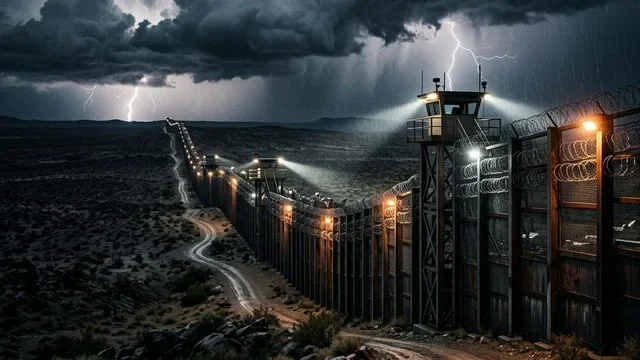
Following a violent military coup in a neighboring nation, thousands of desperate families fled to the border, seeking asylum. The host country, however, ordered the military to shut the gates. The Prime Minister gave a speech claiming that letting them in would open the floodgates, ruin the economy, and destroy the country's national identity. Critics immediately accused him of weaponizing xenophobia and treating the refugees as scapegoats.
The situation escalated when an international human rights tribunal intervened. The tribunal demanded that the borders be opened immediately. They insisted that it is crucial that no refugee be turned away to face certain death. The host nation’s government pushed back, stating that while they sympathize, it is vital that a sovereign nation protect its own citizens first. The legal standoff left thousands stranded in the freezing cold.
4. Grammar Focus: The Subjunctive Mood in Demands
When reporting formal commands, legal demands, or vital recommendations, native speakers use the Subjunctive Mood. In this structure, the verb inside the "that" clause remains in its base form (infinitive without 'to'), no matter who the subject is.
| Trigger Words | Incorrect (Normal Mood) ❌ | Correct (Subjunctive Mood) ✅ |
|---|---|---|
| Demand that... | The UN demands that the border is opened. | The UN demands that the border be opened. |
| Insist that... | They insisted that he assimilates. | They insisted that he assimilate. (No 's' on he/she/it) |
| It is vital/crucial that... | It is vital that she doesn't face deportation. | It is vital that she not face deportation. |
Pro Tip: The subjunctive sounds extremely formal, but it is absolutely necessary when debating legal human rights, tribunal orders, and official policy recommendations.
Exercise A: Choose the Subjunctive Form
1. The international court ruled against the Prime Minister and demanded that the refugees ____________ granted immediate asylum.
2. To prevent exploitation in the workplace, it is crucial that an undocumented worker ____________ basic legal rights.
Exercise B: Complete the Expressions
Type the missing words to complete these heavy idioms.
1. By denying them the right to vote, the government effectively turned them into second-class .
2. The country lost its best doctors and engineers during the war, suffering a massive brain .
5. The Hot Seat: Debate Practice 🎙️
- Does a nation have a moral obligation to grant asylum to anyone fleeing war, or is it justifiable to close the borders to protect the domestic economy?
- When immigrants move to a new country, should they be forced into complete cultural assimilation, or should the country act as a multicultural melting pot?
- Use the Subjunctive Mood: "The human rights organisation demands that the government..." (Complete the sentence).
- How do politicians use xenophobia and scapegoating to win elections during times of economic crisis?
- If an undocumented immigrant has lived peacefully in a country for twenty years and paid taxes, do they deserve a path to citizenship, or immediate deportation?