Does the State Own Your Life?
When a nation goes to war, the volunteer military is rarely enough. Governments often resort to the draft, forcing civilians to pick up weapons and fight. This raises a profound moral question: Does a citizen owe their life to the state in exchange for the rights they enjoy during peacetime? Or is conscription a form of state-sanctioned slavery? In this unit, we explore the vocabulary of combat, nationalism, and defiance.
- Conscription (noun): Compulsory (forced) enlistment for state service, typically into the armed forces; also known as "the draft."
- Nationalism (noun): Identification with one's own nation and support for its interests, especially to the exclusion or detriment of the interests of other nations.
- Conscientious objector (noun): A person who, for reasons of profound moral or religious conscience, refuses to comply with a military draft and will not bear arms.
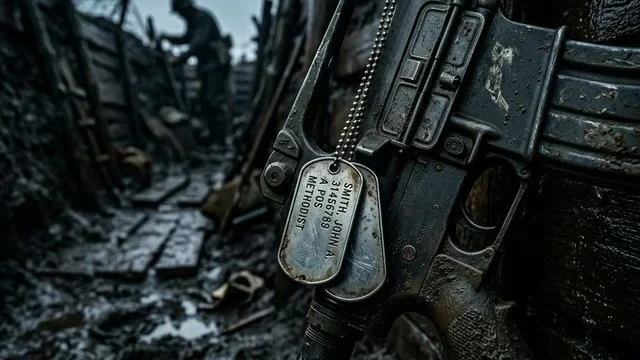
1. Raw Vocabulary: The Frontlines
Practice: drag a word, or select it and choose a gap.
1. The president vowed to protect the nation's from foreign invasion at any cost.
2. Facing heavy losses, the general had no choice but to thousands of unexperienced, freshly drafted recruits.
3. After witnessing the horrors of the frontlines, many soldiers committed and fled into the mountains.
4. The politicians viewed the young, poor recruits as nothing more than cannon .
5. He fled across the border to another country rather than fight, earning the label of a .
6. As the war dragged on for years, civilian and military reached into the millions.
Choose a word, then choose a gap.
2. Idioms and Expressions
Because war is so deeply embedded in human history, many common English idioms originate from the military.
- "Cannon fodder." Soldiers regarded merely as expendable material to be sacrificed in war; troops sent to certain death.
- "Boots on the ground." Ground troops who are on active service in a military operation, engaging in direct physical combat.
- "To draw a line in the sand." To set a firm limit beyond which one will not negotiate or compromise; an ultimatum.
- "A war of attrition." A prolonged conflict during which each side seeks to gradually wear out the other by a series of small-scale actions.
3. Reading: The Letter in the Mail
Read about the ethical and emotional crisis of the draft.
When the hostile neighbour threatened the nation's sovereignty, the government declared a state of emergency. Recognising they needed more boots on the ground, the prime minister signed a conscription bill. Almost overnight, 18-year-old citizens began receiving letters ordering them to deploy.
For many, this was a deeply confusing and terrifying reality. Some marched with fierce nationalism, ready to defend their homes. Others were completely horrified by the prospect of killing. They protested, refusing to be used as cannon fodder in a brutal war of attrition.
The state drew a line in the sand: those who refused to fight were branded as cowardly draft-dodgers and faced prison. However, the exhausted protesters argued that forcing a terrified citizen to bear arms against their will was the ultimate violation of human rights. They declared themselves conscientious objectors, willing to face jail rather than contribute to the rising casualties.
4. Grammar Focus: Participles as Adjectives (-ed vs. -ing)
When debating intense emotional topics, students frequently confuse adjectives that end in -ed and -ing. This drastically changes the meaning of your argument.
| Ending | Rule | Debate Example |
|---|---|---|
| -ING (Present Participle) |
Describes the cause or the source of the feeling. (What is it?) | "The war is terrifying." "The government's demands are exhausting." |
| -ED (Past Participle) |
Describes the receiver of the feeling. (How do they feel?) | "The recruits are terrified." "The exhausted soldiers refused to fight." |
Pro Tip: If you say "I am boring," you are saying you cause other people to fall asleep! If you want to describe your feeling, say "I am bored."
Exercise A: Choose the Correct Participle
1. Being forced to fight against your will is a deeply ____________ experience.
2. The ____________ citizens protested outside the parliament building, refusing to be drafted.
Exercise B: Complete the Expressions
Type the missing words to complete these heavy idioms.
1. The generals didn't care about the lives of the poor recruits; they just treated them as cannon .
2. The president refused to negotiate any further, completely drawing a line in the .
5. The Hot Seat: Debate Practice 🎙️
- Does a citizen owe their life to the state? Is conscription a necessary duty to protect a nation's sovereignty, or a violation of human rights?
- How do governments use nationalism to convince young, terrified recruits to become boots on the ground?
- Use -ED and -ING adjectives: "The reality of a war of attrition is absolutely (shocking/shocked), leaving the public feeling completely (shocking/shocked)." (Fill in the blanks).
- Should a conscientious objector be allowed to refuse service, or should they be imprisoned as a draft-dodger while others die in their place?
- If a leader declares a war but refuses to deploy their own children to the frontlines, are they just treating the working class as cannon fodder?