More than just a defender.
In modern football, saying someone is a "midfielder" isn't enough. You have to explain exactly what their job is. A scout evaluating a player, or a manager assigning a role, relies heavily on Defining Relative Clauses. These grammar structures allow you to attach a specific action to a specific noun (e.g., "A player who dictates the tempo").
- Work rate (noun): The amount of physical effort and running a player puts into a match, especially when they don't have the ball.
- Outfield player (noun): Any player on the pitch who is not the goalkeeper.
1. The Tactical Vocabulary: 8 Player Roles
Practice: drag a word, or select it and choose a gap.
1. We need a creative who can thread a pass through their tight defense.
2. The is the anchor of the team; he rarely goes forward, choosing instead to protect the defense.
3. He isn't very involved in the build-up play, but as a pure , if the ball falls to him in the box, he scores.
4. To play as a modern , you need the stamina to sprint up and down the touchline for 90 minutes.
5. Hit the long ball up to the so he can control it with his chest and bring others into play.
6. Our has an incredible work rate; he was defending our box one minute and scoring in theirs the next.
7. The captain is a dominant who wins every header in the penalty area.
8. The needs to beat his defender and deliver a high cross into the box.
Choose a word, then choose a gap.
2. Essential Expressions for Player Roles
Scouts and coaches use these 6 expressions to evaluate a player's specific tactical duties.
- "He plays as a..." Simplified: The primary position or role this person occupies on the pitch.
- "Break up the play." Simplified: To interrupt and stop the opponent's attacking moves (usually the job of a holding midfielder).
- "Make overlapping runs." Simplified: When a defender sprints past the winger on the outside to offer an attacking passing option.
- "Hold up the ball." Simplified: To keep possession of the ball under physical pressure while waiting for teammates to arrive.
- "Drop into the pocket." Simplified: To move backward into the empty space between the opponent's midfield and defense to receive a pass.
- "Dictate the tempo." Simplified: To control the speed of the game by deciding whether to pass fast or slow down the play.
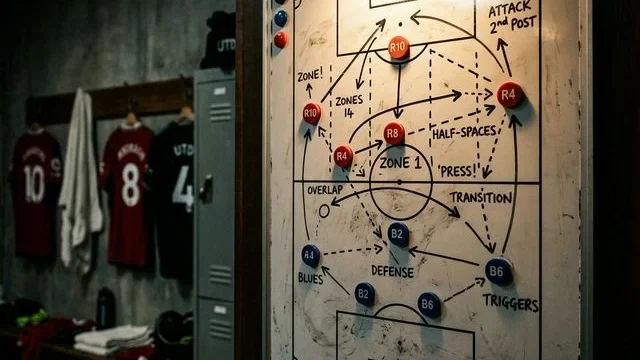
3. Grammar Mechanics: Defining Relative Clauses
A defining relative clause gives essential information about a noun. Without it, the sentence doesn't make sense. In football analysis, we use them constantly to define exactly what type of player we are talking about.
| Relative Pronoun | Usage | Tactical Example |
|---|---|---|
| Who / That | Used for people (players, managers, referees). | "We need a center-back who can pass the ball." "He is the player that dictates the tempo." |
| Which / That | Used for things or tactics. | "We play a formation which requires fast wingers." |
| Where | Used for places or zones on the pitch. | "The flank is the zone where we have the most space." |
Pro Tip: You do NOT use commas before defining relative clauses.
4. Reading: The Scouting Report
Notice how the Manager and Scout use defining relative clauses to discuss the exact profile of player they want to sign.
5. Interactive Practice: Defining the Squad
Exercise A: Choose the Relative Pronoun
1. "A poacher is a striker ___________ specializes in scoring inside the penalty area."
2. "The touchline is the area ___________ the manager usually stands to shout instructions."
Exercise B: Complete the Expressions
Type the missing words to complete these tactical evaluations.
1. We need a midfielder who can break the play defensively.
2. The striker's job is to hold the ball until help arrives.
6. Dressing Room Speaking Practice 🎙️
- Use a defining relative clause (with "who") to explain the difference between a playmaker and a holding midfielder.
- Roleplay: You are a scout. Tell your manager about a new full-back you found "who likes to make overlapping runs."
- Why is it important for a target man to be able to hold up the ball?
- Describe a specific zone on the pitch using the word "where" (e.g., "The six-yard box is the area where...").