Laying out the blueprint.
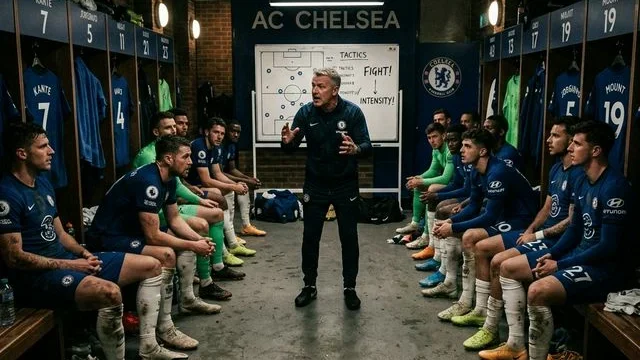
Before the players walk down the tunnel, the manager delivers the team talk. This is where the tactical game plan is finalized. To explain exactly how the team will operate against the opposition, the manager uses Future Tenses. Knowing the difference between "we will," "we are going to," and "we are playing" is the difference between a spontaneous idea and a strict tactical formation.
- The Dressing Room (noun): The locker room where players change, receive tactical briefings, and recover.
- The Starting XI (noun): The eleven players chosen to start the match on the pitch.
1. The Tactical Vocabulary: 8 Strategic Terms
Practice: drag a word, or select it and choose a gap.
1. We are going to change the from a 4-3-3 to a 3-5-2 to give us more width in midfield.
2. They are slow at the back. When we lose the ball, apply a immediately to force a mistake.
3. As soon as we win possession, hit them on the using the pace of our wingers.
4. We want to the left flank by pushing both the winger and the full-back high up the pitch.
5. They have world-class strikers, so we will sit in a and absorb the pressure.
6. The is simple: keep a clean sheet for the first 20 minutes and frustrate the home crowd.
7. We are vulnerable during the ; when we lose the ball, drop back instantly.
8. How are they going to for corners today? Zonal marking or man-to-man?
Choose a word, then choose a gap.
2. Essential Expressions for the Team Talk
The manager will use these 6 idioms and expressions to communicate the team's attitude and tactical approach before kick-off.
- "Keep it tight at the back." Simplified: Defend solidly, do not leave gaps, and do not concede any easy goals.
- "Play on the front foot." Simplified: Be aggressive, take the initiative, and attack from the very first minute.
- "Hit them on the break." Simplified: Execute a fast counter-attack when the opponent's defense is out of position.
- "Dictate the play." Simplified: Control the possession and the speed of the match; make them chase the ball.
- "Park the bus." Simplified: A highly defensive strategy where almost all players stay behind the ball to protect a lead.
- "Put a shift in." Simplified: Work incredibly hard physically; run for the entire 90 minutes.
3. Grammar Mechanics: Strategy in the Future Tense
When a manager delivers a game plan, they must differentiate between fixed formations, intended strategies, and promises/commands regarding effort.
| Future Form | Tactical Usage | Dressing Room Example |
|---|---|---|
| Present Continuous (am/is/are + verb-ing) |
Fixed Arrangements. Used to state the starting formation or setup that is already decided. | "We are playing a 4-4-2 today." "Smith is starting on the left flank." |
| Going to + Base Verb | Prior Intentions. Used to explain the tactical game plan and how we intend to play. | "We are going to press them high." "They are going to park the bus." |
| Will + Base Verb | Promises & Commands. Used to demand effort or predict consequences. | "You will put a shift in today!" "If we lose focus, they will punish us." |
4. Reading: The Pre-Match Briefing
Notice how the Manager uses all three future forms to outline the strategy against a tough opponent.
5. Interactive Practice: Confirming the Game Plan
Exercise A: Choose the Correct Future Form
1. The manager is confirming the starting lineup, which was decided yesterday. "Jones ___________ as the holding midfielder today."
2. The manager is explaining the tactical intention for the second half. "When they get tired, we ___________ them high up the pitch."
Exercise B: Complete the Expressions
Type the missing words to complete these vital dressing room instructions.
1. Don't concede early; keep it at the back.
2. We have the pace advantage, so we are going to hit them on the .
6. Dressing Room Speaking Practice 🎙️
- Roleplay: You are the manager. Explain to your team that you are playing a 4-3-3 formation today, and that you are going to use a high press.
- When is it tactically smart for a team to park the bus?
- Why does a manager demand that players put a shift in? Use "will" to explain what happens if they don't.
- Explain the difference between playing on the front foot and using a low block.