Lights, camera, positioning.
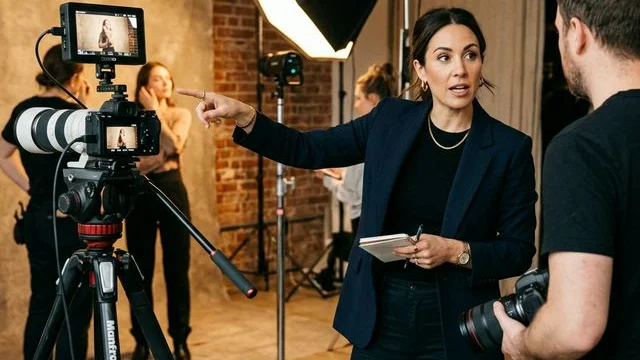
Once the boundaries are set, the focus shifts to the visual production. A director or cameraperson will guide your movements to capture the best lighting and angles. Understanding exactly where you need to be—and how to move in relation to the camera—requires a solid grasp of Prepositions of Place and Movement. Following spatial directions accurately keeps the shoot safe and efficient.
- Hit your mark (phrase): To move to the exact spot on the floor (often marked with tape) where you need to stand for the shot.
- Wrap (verb/noun): To finish filming for the day.
1. The Industry Vocabulary: 8 Words for the Camera
Practice: Drag the correct vocab into the professional sentences!
1. Please step forward so you are standing directly on your .
2. We are going to shoot this scene from a perspective to make it more immersive.
3. The is slightly off; you are too far to the left of the screen.
4. Could you clear those coffee cups out of the before we roll?
5. Let's do a smooth from the couch down onto the floor.
6. Move closer to the window; we need to utilize the natural .
7. The camera is too low; let's raise the tripod a few inches.
8. We want the prop to be clearly visible in the while you speak.
2. Essential Expressions for Spatial Direction
Directors will frequently use these 6 expressions to adjust your positioning. Know what they mean so you can adjust seamlessly.
- "Please hit your mark." Simplified: Move to the exact spot taped on the floor.
- "Turn towards the main light." Simplified: Rotate your body so the brightest light hits your face.
- "We are shooting a POV angle." Simplified: The camera will act as the eyes of your partner.
- "Adjust your framing." Simplified: Shift your body so you are properly centered inside the camera shot.
- "Step away from the edge." Simplified: Move backwards to ensure your physical safety or better composition.
- "Let's reset the scene." Simplified: Go back to your starting positions and begin the action again.
3. Grammar Mechanics: Place vs. Movement
To follow instructions accurately, you must know the difference between Prepositions of Place (where you are static) and Prepositions of Movement (where you are going).
| Category | Common Prepositions | Professional Example |
|---|---|---|
| Place (Static Position) |
In front of, Behind, Next to, Above, Below, Between | "Stand in front of the ring light." "Keep your hands above the frame." |
| Movement (Direction / Action) |
Towards, Away from, Into, Out of, Across, Through | "Walk slowly towards the camera." "Turn away from the window." |
4. Reading: The Director's Notes
Notice how the Director uses prepositions to adjust the Performer's position on set.
5. Interactive Practice: Hitting Your Mark
Exercise A: Place or Movement?
1. "Please move the chair ___________ the wall so it isn't blocking the door."
2. "Keep your face positioned directly ___________ the camera lens."
Exercise B: Complete the Expressions
Type the missing words to complete these vital set directions.
1. Please hit your so the camera can focus.
2. Turn your face the main light to avoid shadows.
6. Professional Speaking Practice 🎙️
- Roleplay: You are directing a co-star. Use prepositions of movement to tell them how to enter the room and approach the bed.
- Why is it crucial for performers to hit their mark consistently on a professional set?
- Describe the difference between shooting a scene from a third-person angle versus a POV perspective.
- Use the expression "Let's reset the scene" in a sentence to politely stop a shoot because the lighting shifted.
Protect Your Independence 💼
Looking to secure premium rates, negotiate iron-clad contracts, and establish strict boundaries without hesitation? Don't just read about it—practice it.
Come and join me for a bespoke English lesson at nativeuk.com tailored specifically for independent creators. Let's fine-tune your professional communication in complete privacy.
Book a Private SessionMaster the Native Nuance 💡
Want to sound even more articulate during live broadcasts, or perhaps drop a naturally professional idiom during your next stream?
Check out our Good to Know section and dive into our Blog. You’ll be steering conversations like a native speaker in no time.
Explore Free Resources