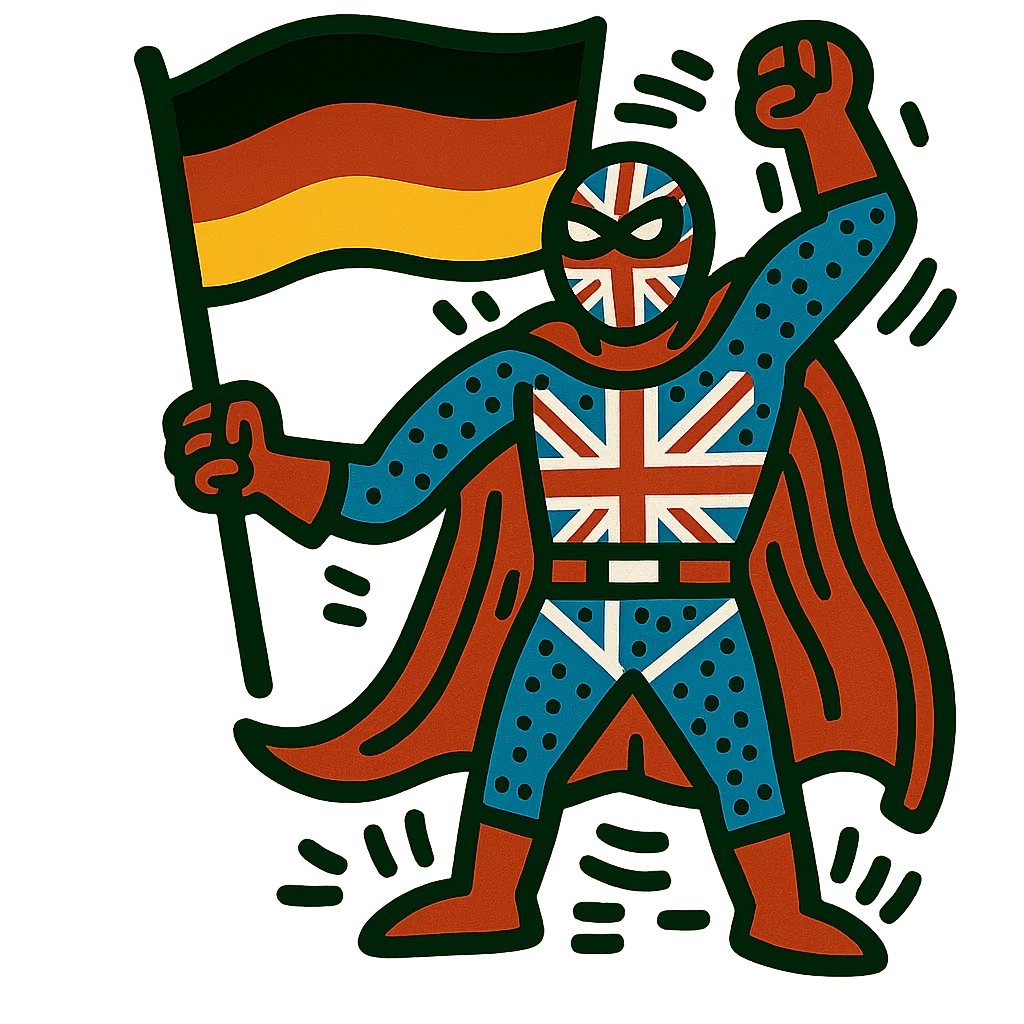
Top 10 Mistakes German Learners Make When Learning English
German and English are cousins in the language family, but that sometimes makes it harder! "Denglisch" mistakes are very common. Here are the top errors German speakers make.
Top 10 Mistakes
1
❌ Typical learner sentence:
"Can I get a steak? I want to become a steak."
🤔 Why learners say this:
FALSE FRIEND! 'Bekommen' means 'to get/receive', but 'Become' means 'to transform into'.
🇬🇧 What it sounds like to a Brit:
Like you want to magically transform your body into a piece of meat!
✅ Natural English version:
"I would like to have a steak." (or 'get a steak')
2
❌ Typical learner sentence:
"I have a new Handy."
🤔 Why learners say this:
Germans use the English word 'Handy' for mobile phones. In English, 'handy' means 'useful' or 'good with hands'.
🇬🇧 What it sounds like to a Brit:
It sounds like you have a new useful tool, not a phone.
✅ Natural English version:
"I have a new mobile." (or cell phone)
3
❌ Typical learner sentence:
"We made a party yesterday."
🤔 Why learners say this:
German 'eine Party machen' uses 'make'. English uses 'have' or 'throw'.
🇬🇧 What it sounds like to a Brit:
Like you constructed the party from scratch materials.
✅ Natural English version:
"We had a party yesterday."
🎯 Practice: Which Word?
You are at a restaurant. You say:
A) I want to become a salad
B) I want to get a salad
4
❌ Typical learner sentence:
"I work here since 10 years."
🤔 Why learners say this:
German uses 'seit' for duration. English requires 'for' + duration.
🇬🇧 What it sounds like to a Brit:
Classic confusion. We only use 'since' with a specific date (Since 2012).
✅ Natural English version:
"I have worked here for 10 years."
5
❌ Typical learner sentence:
"Please make a photo of us."
🤔 Why learners say this:
German 'ein Foto machen' uses 'make'. English ALWAYS uses 'take'.
🇬🇧 What it sounds like to a Brit:
Like you want us to paint or develop the photo in a darkroom.
✅ Natural English version:
"Please take a photo of us."
6
❌ Typical learner sentence:
"I have birthday today."
🤔 Why learners say this:
Direct translation of 'Ich habe heute Geburtstag'.
🇬🇧 What it sounds like to a Brit:
A bit strange. We say it IS our birthday.
✅ Natural English version:
"It is my birthday today."
🎯 Practice: Fix the Sentence
"Can you make a photo with my handy–
7
❌ Typical learner sentence:
"We see us tomorrow!"
🤔 Why learners say this:
German 'Wir sehen uns' (reflexive). English doesn't use the reflexive here.
🇬🇧 What it sounds like to a Brit:
Like we are looking in a mirror together.
✅ Natural English version:
"See you tomorrow!"
8
❌ Typical learner sentence:
"I know a good place where we can eat." (Pronounced 'vere' and 've')
🤔 Why learners say this:
The 'W' vs 'V' mix-up. German W sounds like English V.
🇬🇧 What it sounds like to a Brit:
The classic "German villain" accent. Remember: W is round lips (like a kiss), V is teeth on lip.
✅ Natural English version:
"I know a good place where we can eat." (Watch the Ws!)
9
❌ Typical learner sentence:
"I drove with the bus."
🤔 Why learners say this:
German 'Ich bin mit dem Bus gefahren'. In English, you only 'drive' if you are the driver.
🇬🇧 What it sounds like to a Brit:
Like you stole the bus and drove it yourself!
✅ Natural English version:
"I took the bus." (or 'went by bus')
10
❌ Typical learner sentence:
"I am not allowing to do that."
🤔 Why learners say this:
Confusion with passive voice. 'I am not allowed' (passive) vs 'I am not allowing' (active).
🇬🇧 What it sounds like to a Brit:
Like you are the boss forbidding someone else, when you mean YOU can't do it.
✅ Natural English version:
"I am not allowed to do that."
🎯 Practice: Fix the Sentence
"I drove with the train to Berlin."
Ready to Perfect Your English?
English lessons online with a native English speaker on Zoom, Teams, and Google Meet
Let's SPEAK English!