
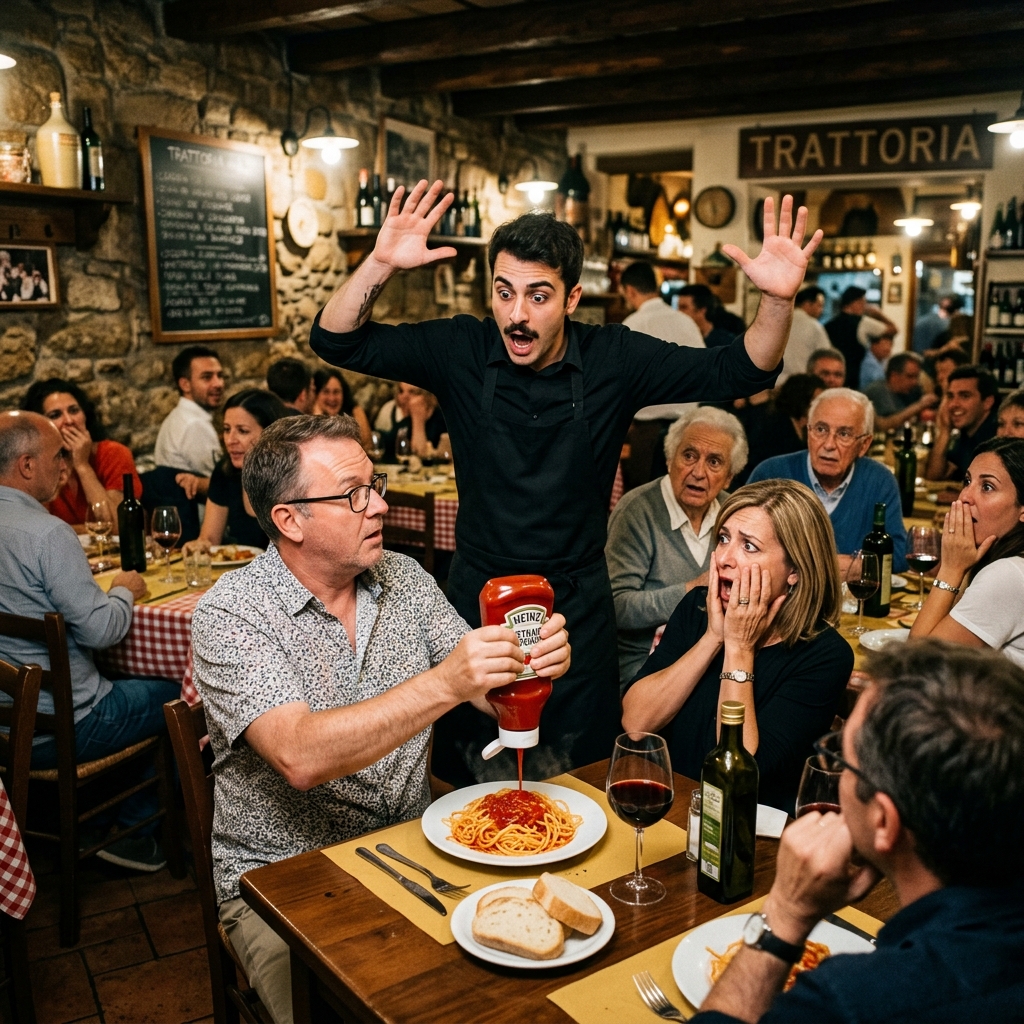
Rome is a city of ancient history, beautiful art, and, above all else, strict culinary rules. Last Tuesday, at 'Da Luigi,' a traditional family-run trattoria near the Pantheon, a simple lunch turned into a full-blown diplomatic incident. A 32-year-old British tourist, Gary Thompson, was halfway through a beautiful bowl of Spaghetti Carbonara when he committed the unthinkable: he asked the waiter for a bottle of ketchup. The reaction from the staff was immediate, dramatic, and you might say over-the-top. It was an extreme sense of national pride with a foreigner doing the unthinkable.
The waiter, who has worked at the restaurant for twenty years, reportedly stopped dead in his tracks. According to witnesses, the entire restaurant went silent. "I thought he was joking," the waiter said later, still visibly shaken. "But he was serious. He said the pasta was a bit 'dry' and needed some red sauce. To ask for ketchup on a Carbonara is not just a mistake; it is an insult to my grandmother, my country, and the very soul of Italy." The owner was called, and within minutes, Mr. Thompson was politely but adamantly asked to leave the premises. It was a "ridiculous" situation that Gary says left him feeling "confused and hungry."
"I just like ketchup. I put it on everything. Roast dinners, fish and chips, even my breakfast. I didn't realise this simple condiment would cause a riot. The waiter looked at me like I'd just set fire to the Colosseum."
The incident has since gone viral on Italian social media, with many locals praising the restaurant for its principled stand against culinary barbarism. In Italy, the traditions of pasta are protected with a ferocity that can seem as a bit much to outsiders. There are unwritten laws about which pasta shapes go with which sauces, and the idea of adding a sugary, vinegar-based tomato sauce to a delicate egg and guanciale dish is enough to make any Roman chef's blood boil. It’s a hard to understand cultural divide that highlights just how seriously the Italians take their dinner.
Waiters in Rome are often trained to gently steer tourists away from common mistakes, like ordering a cappuccino after 11 AM or asking for pineapple on a pizza. However, the ketchup request was so far beyond the pale that the usual politeness was abandoned. "We have a reputation to uphold," the owner of 'Da Luigi' explained. "If we allow one person to put ketchup on their spaghetti, what is next? Mayonnaise on the lasagna? It is a slippery slope to a culinary disaster. We have a responsibility to protect our heritage."
For Mr. Thompson, the experience was a lesson in the importance of local etiquette. "I've learned my lesson" he admitted, while eating a sandwich on a park bench nearby. "Next time I go to an Italian restaurant, I'll stick to the salt and pepper. Or maybe I'll just bring my own little bottle and hide it under the table." His comment, while lighthearted, reflects the struggle many travellers face when their personal tastes clash with deep-seated cultural traditions. It is a stark reminder that when in Rome, you should probably do as the Romans do and that definitely doesn't involve ketchup.
As the sun sets over the Tiber, the story of the "Ketchup Crime" continues to be the talk of the city's cafes and wine bars. For the people of Rome, it is a humorous but important victory for tradition. For the tourists, it is a cautionary tale about the power of food and the boundaries of good taste. Whether you agree with the restaurant's decision or think it was a bit daft, one thing is certain: in the world of Italian cuisine, the chef is always the boss, and some rules are simply not meant to be broken.
In the aftermath of the scandal, 'Da Luigi' has seen a surge in bookings from local residents who want to support a business that "respects the pasta." Meanwhile, Gary Thompson has become something of a minor celebrity in his hometown of Essex, where his friends have started calling him The Ketchup Kid.
💬 Reader Comments
Loading comments...