
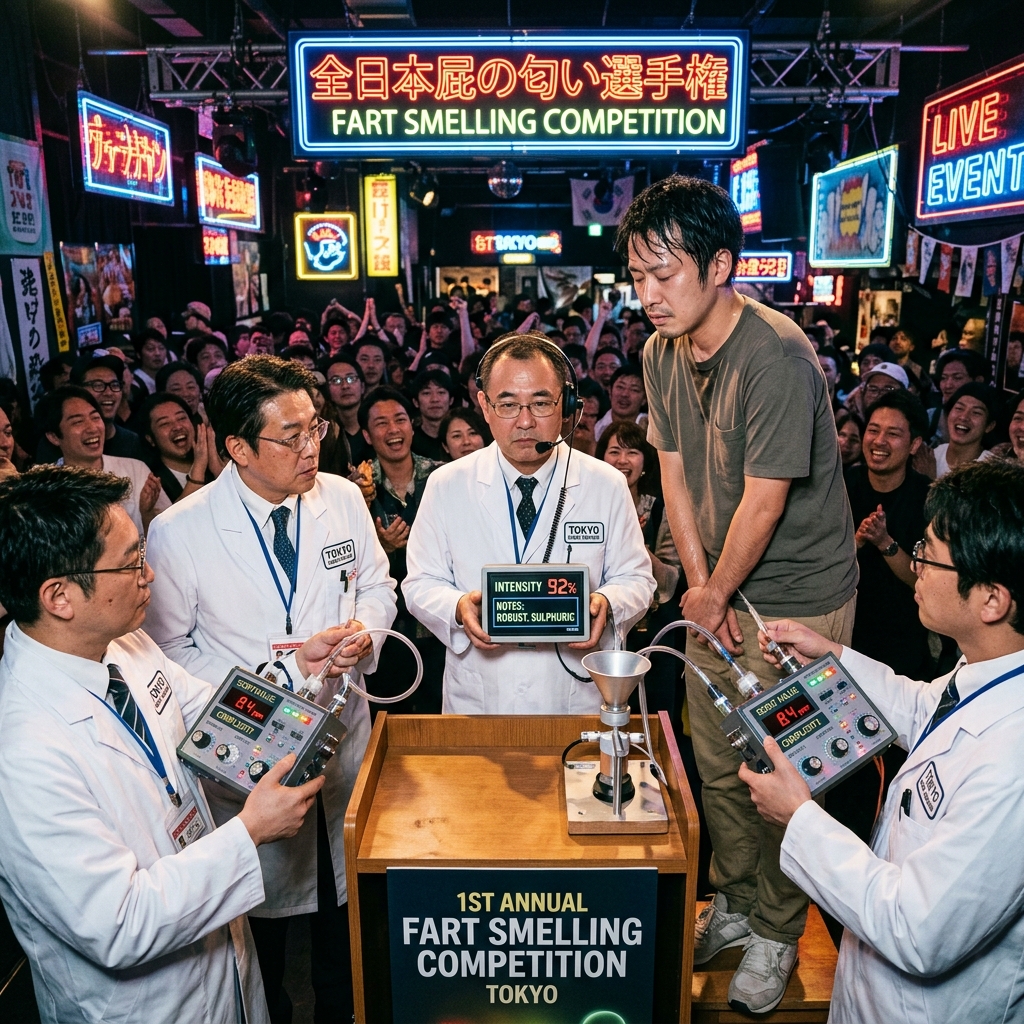
In a city known for its meticulous attention to detail and high-tech innovation, it was perhaps only a matter of time before even the most revolting aspects of human biology were turned into a spectator sport. The Tokyo Scent Invitational held last weekend was not, as the name might suggest, a gathering of luxury perfume makers. Instead, it featured a panel of ten lab-coated judges whose task was to evaluate, rank, and describe the gaseous emissions of dozens of brave contestants. It was an extraordinary display of scientific rigour applied to an unusual subject.
The rules of the competition were surprisingly rigorous. Contestants were required to follow a specific diet for three days prior to the event, involving heavy helpings of fermented beans, onions, and various cabbage-based dishes. When the time came to perform, they stood on a raised platform behind a curtain, while the judges used sophisticated air-capture devices to channel the samples directly to their nostrils. The goal was not just to produce the loudest or most offensive smell, but to create a complex aroma profile that could be identified and categorised by the experts.
"It's about the layers. A truly champion emission has an initial sharp note, followed by a lingering, earthy finish. It's fascinating how much technique is involved in a good whiff."
One judge, a retired chemistry professor who asked to remain anonymous, explained that the panel looks for characteristics such as pungency, persistence, and "floral undertones." While the audience watched on screens showing real-time chemical breakdowns of each sample, the atmosphere in the hall was one of intense, silent concentration. For the winner, a 28-year-old software engineer named Hiroshi, the victory was a dream come true. "I've always known I had a special gift," he said through a translator. "To be recognised by the professionals is the highest honour I could imagine."
Despite the obvious humour of the situation, the event actually has a serious side. The organisers insisted that by studying the chemical composition of flatulence, they can gain valuable insights into gut health and digestion. However, for most of the people who packed the hall, it was simply an opportunity to witness one of the most unusual events in the Japanese calendar. It proves once again that in Tokyo, if you can imagine it, there is probably a competition for it, no matter how questionable it might seem to the rest of the world.
As the competition concluded, the crowd erupted into applause for the new champion, Hiroshi, who accepted his trophy with tears in his eyes. The event's success has already led to talks of a global tour, with potential stops in London and New York. "We want to take this to the world stage," Jean-Pierre, one of the event's co-founders, remarked while adjusting his protective eyewear. "Everyone has a story to tell, and sometimes that story is told through the air we breathe. It's fascinating, but it's also a celebration of being human."
The aftermath of the event was just as colourful as the competition itself. Social media was flooded with memes and videos of the Whiffers of Tokyo, making it a viral sensation overnight. Some critics have called the event revolting and a waste of scientific resources, but for the fans, it was a breath of fresh air—literally. In a world that often takes itself too seriously, the Tokyo Scent Invitational provided a much-needed moment of levity and laughter. It reminds us that no matter how sophisticated we become, there is always room for a bit of harmless fun.
Looking ahead, Hiroshi plans to defend his title next year and is already experimenting with new dietary combinations to enhance his performance. "I'm looking at spicy fermented cabbage next," he hinted with a wink. For the people of Tokyo, the competition has become a highlight of the social calendar, proving that even the most unusual ideas can become a cultural phenomenon. As they say in the city, the future is bright, and it smells a lot like cabbage.
💬 Reader Comments
Loading comments...