The Final Sentence.
Capital punishment remains one of the most dividing issues in global law. Supporters argue it is the only fair response to the worst crimes, providing peace to victims' families and serving as a strict warning. Opponents argue that state killing is violent and point to the terrifying reality of innocent people being sentenced to die. In this unit, we separate true justice from angry revenge.
- Capital punishment (noun): The legally authorized killing of someone as punishment for a crime.
- Retribution (noun): Punishment given to someone as revenge for a terrible wrong they have done.
- Death row (noun): A special section of a prison that houses criminals waiting to be killed by the state.
1. Raw Vocabulary: Life and Death Decisions
Practice: Drag the correct legal term into the debate!
1. The governor refused to show , and the punishment proceeded as scheduled.
2. Opponents argue that there is no statistical evidence that the death penalty acts as an effective to murder.
3. New DNA evidence helped to the man's name after 20 years in prison.
4. Human rights organisations are campaigning globally to capital punishment entirely.
5. The prisoner's lawyers filed a final to the Supreme Court just hours before midnight.
6. Today, a lethal is the most common method of capital punishment in some countries.
7. Is it ever morally acceptable for governments to their own citizens?
8. You cannot give someone the death sentence without 100% solid .
2. Idioms and Expressions
When debating morality and the justice system, native speakers rely on these evocative phrases.
- "An eye for an eye." The principle that a criminal should be punished to the same exact degree as their crime caused pain.
- "A miscarriage of justice." A massive failure of a court system that results in an innocent person going to jail.
- "Beyond a reasonable doubt." The legal standard that there must be absolutely no logical explanation other than that the person is guilty.
- "To have blood on one's hands." To share personal responsibility for the death or suffering of someone else.
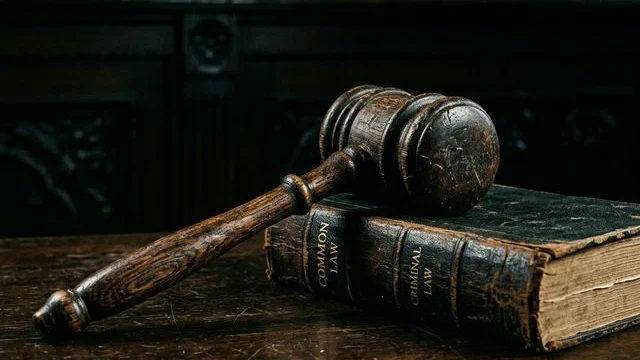
3. Reading: The Wrong Man
Read this harrowing account of a systemic failure.
In 1998, Thomas Vance was sent to prison for a brutal murder. He constantly claimed he was innocent, but the jury believed the police had proven his guilt beyond a reasonable doubt. Thomas spent 18 years trapped on death row, exhausted after losing every single appeal.
Just weeks before the state planned to execute him, a charity secured funding to test DNA from the crime scene using modern technology. The new medical proof definitively showed that Thomas was not the killer. The governor intervened, and Thomas's name was finally cleared.
While Thomas is now a free man, human rights groups point to his case as a terrifying near-miss. "If that test hadn't happened, the state would have blood on its hands," a spokesperson said. "A miscarriage of justice is always terrible, but death is permanent."
4. Grammar Focus: Mixed Conditionals
When we want to talk about how a past event (or a past mistake) affects the present reality, we use a Mixed Conditional. It mixes the Third Conditional (unreal past) with the Second Conditional (unreal present).
| Structure | Meaning | Debate Example |
|---|---|---|
| If + Past Perfect, ... would/wouldn't + Base Verb | A hypothetical past condition with a hypothetical present result. | "If they had executed him in 1998, an innocent man would be dead today." (They didn't execute him, so he is alive today). |
| If + Past Perfect, ... would/wouldn't be + verb-ing | A hypothetical past condition affecting an ongoing action right now. | "If the DNA hadn't been tested, he would still be sitting in prison." (It was tested, so he is not sitting there). |
Exercise A: Build the Mixed Conditional
1. If the jury ____________ the real killer back in 1998, Thomas Vance wouldn't be dealing with severe trauma right now.
2. If they had banned the death penalty years ago, the state ____________ blood on its hands today.
Exercise B: Complete the Expressions
Type the missing words to complete these heavy idioms.
1. Sending an innocent person to prison for 20 years is a massive miscarriage of .
2. Some people believe in pure retribution: an eye for an .
5. Debate Support: Prepare Your Arguments
Before you debate, look at these points and use the sentence starters below.
- Some crimes are so terrible that the killer loses their right to live.
- It gives the victims' families true closure and a sense of justice.
- The fear of the death penalty stops other people from murdering.
- Killing criminals makes the government just as bad as the murderers.
- Courts make mistakes, and killing innocent people is unacceptable.
- Life in prison without any release is almost a worse punishment.
- "If we had banned it earlier, we wouldn't be..." (Mixed Conditional)
- "You cannot trust the legal system completely. A miscarriage of justice means..."
- "For certain evil acts, the only fair response is..."
- "Life in a terrible prison functions better as a warning because..."
6. The Hot Seat: Debate Practice 🎙️
- Do you believe the principle of "an eye for an eye" is a valid foundation for a modern legal system?
- Is the death penalty truly an effective warning, or are murderers rarely thinking about the consequences?
- If a government accidentally kills an innocent person, do they have blood on their hands? Should the judge face consequences?
- Use a Mixed Conditional: If your country had banned the death penalty 50 years ago, how would the justice system be different today?
- What criteria must be met for a jury to convict someone beyond a reasonable doubt?
Dominate the Discussion 🎙️
Don't just nod your head in conversations. Master the advanced phrasing to eloquently defend your opinions in high-level debates.
Come and join me for a bespoke English lesson at nativeuk.com designed specifically to build your conversational confidence.
Book a Private SessionMore Free Topics? 📰
Want to speak clearly about politics, tech, and the modern world? We've got the secret vocabulary you won't find in textbooks.
Check out our Good to Know section and dive into our Blog. You’ll be leading conversations like a native speaker in no time.
Explore Free Resources