Explaining the Pain.
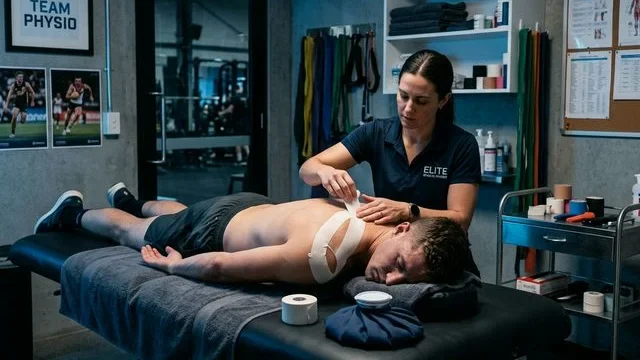
A minor niggle can become a major, season-ending tear if it isn't communicated properly. When you sit on the treatment table, the physio needs to know exactly which muscle or joint is hurt, and crucially, *how long* it has been hurting. To describe an ongoing pain or a continuous recovery, you need to use the Present Perfect Continuous tense.
- The Physio (noun): Short for physiotherapist. The medical professional responsible for treating and preventing player injuries.
- Niggle (noun): A minor, persistent pain or discomfort that isn't a severe injury but is annoying to play with.
1. The Medical Vocabulary: 8 Injury Terms
Practice: drag a word, or select it and choose a gap.
1. The striker pulled up grabbing the back of his leg; it looks like a torn .
2. He landed awkwardly after jumping for a header and managed to his ankle.
3. A complete rupture of the anterior cruciate in the knee will keep him out for 9 months.
4. Overstretching to reach the ball caused a painful in his calf muscle.
5. Changing direction too quickly on a slippery pitch often leads to a injury.
6. The clash of heads looked terrible; he must be checked immediately for a .
7. We won't know exactly how bad the tear is until we send him to the hospital for an MRI .
8. After the surgery, he will need at least three months of intensive in the gym.
Choose a word, then choose a gap.
2. Essential Expressions for the Treatment Table
Use these 6 common phrases to accurately describe what you are feeling to the medical staff.
- "My hamstring feels tight." Simplified: The muscle feels stiff and restricted, which is often a warning sign before a tear.
- "I tweaked my knee." Simplified: I hurt it slightly. A "tweak" is a minor, sudden pain, but not necessarily a major injury.
- "I rolled my ankle." Simplified: I stepped on the side of my foot, causing the ankle to bend outward sharply (causing a sprain).
- "It's tender to the touch." Simplified: The area is very sensitive and hurts when someone presses on it with their fingers.
- "I need to come off." Simplified: I am too injured to continue playing; tell the manager to substitute me.
- "We'll assess it tomorrow." Simplified: We will wait to see how it feels after a night's rest before making a medical decision.
3. Grammar Mechanics: Present Perfect Continuous
When you sit on the treatment table, the physio will usually ask: "How long has it been hurting– To answer correctly, you must use the Present Perfect Continuous. This tense describes an action (or a pain) that started in the past and is still continuing right now.
| Structure | Keyword Triggers | Medical Example |
|---|---|---|
| has / have been + verb-ing | Since (a specific point in time: Since Tuesday, Since the tackle) | "My ankle has been swelling since yesterday." |
| has / have been + verb-ing | For (a duration of time: For 20 minutes, For three weeks) | "I have been feeling this niggle for two weeks." |
Pro Tip: Use the Past Simple if the pain started and completely stopped in the past. (e.g., "It hurt yesterday, but it feels fine today.") Use Present Perfect Continuous if it still hurts right now.
4. Reading: On the Treatment Table
Notice how the Player uses the Present Perfect Continuous to explain the history of his injury to the Physio.
5. Interactive Practice: The Medical Assessment
Exercise A: Build the Present Perfect Continuous
1. "My hamstring ___________ me pain since the match on Saturday." (Give)
2. "I ___________ ice on my ankle for the last 20 minutes." (Put)
Exercise B: Complete the Expressions
Type the missing words to complete these common medical complaints.
1. I landed awkwardly on my foot and my ankle.
2. Don't press too hard there, doc, it's very to the touch.
6. Dressing Room Speaking Practice 🎙️
- Roleplay: You are speaking to the physio. Tell them you tweaked your hamstring and that it has been hurting since yesterday.
- What is the difference between a strain and a sprain? Which body parts usually suffer from each?
- Why is it dangerous for a player to ignore a small niggle and keep playing?
- Practice delivering the phrase "I need to come off!" while jogging over to the touchline.