
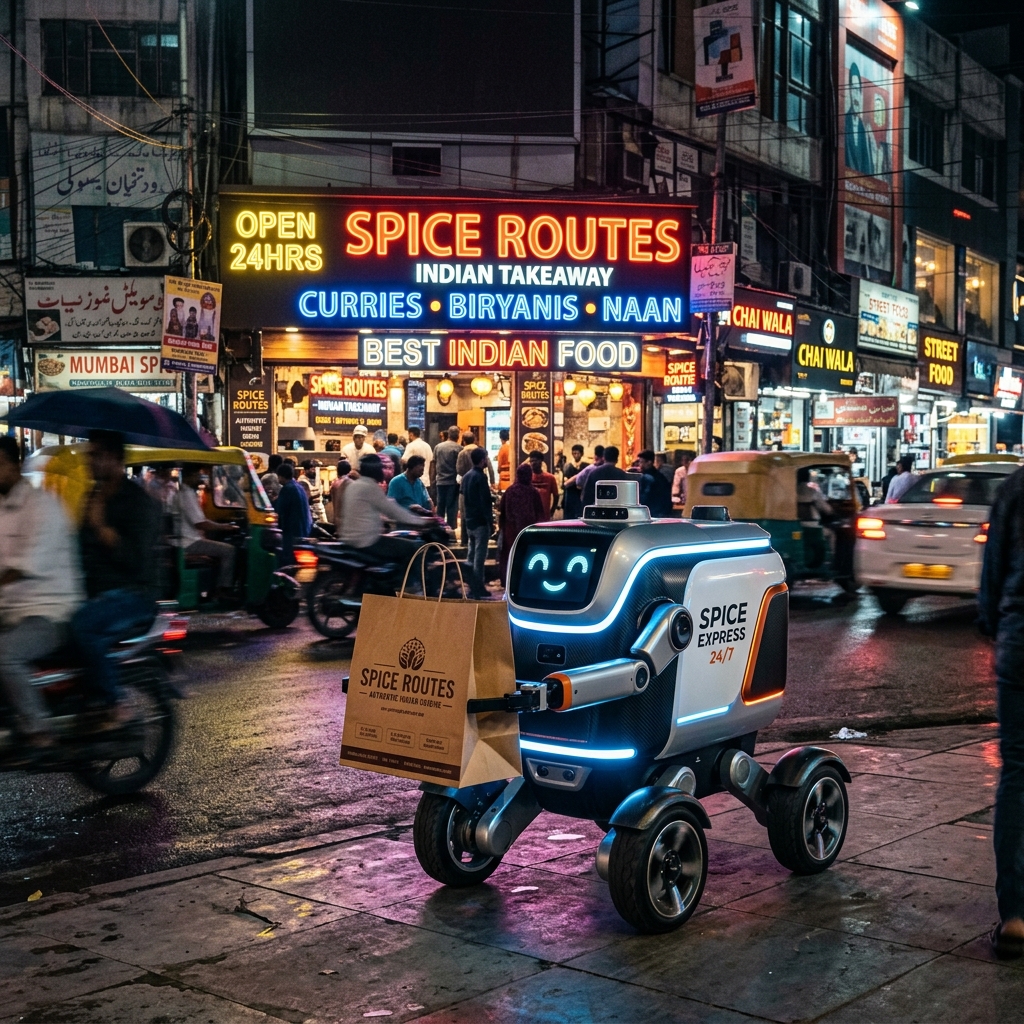
The Balti-Bot has officially arrived. In a move that has sparked both excitement and a fair bit of controversy, The Spice Route in central Birmingham has become the first Indian takeaway in the country to fire all of its human delivery drivers. Replacing the familiar sight of scooters weaving through traffic is a fleet of ten high-tech, six-wheeled robots that navigate the pavements at a steady four miles per hour. It’s a monumental shift for a business that has relied on local knowledge and human speed for over thirty years.
The owner, Mr. Raj Patel, explained that the decision was based purely on efficiency and cost. "The robots don't get stuck in traffic, they don't need breaks, and they never get lost," he said in a recent interview. "Plus, they don't ask for tips, which our customers seem to appreciate. We are living in the future, and if the future involves a robot bringing you a piping hot Vindaloo, then I am all for it." Each robot is equipped with GPS, cameras, and thermal insulation to ensure the food stays piping hot during the journey.
"It's a bit eerie seeing a white box on wheels rolling up your driveway at 9 PM. But you can't argue with the service. My Tikka Masala was still steaming, and the robot even said 'Have a nice evening' in a very polite voice."
However, not everyone is happy about the new "Curry-Bots." Local delivery driver unions have described the move as beyond the pale, arguing that it deprives hard-working people of their livelihoods for the sake of a few extra pounds in profit. There have also been reports of the robots being bullied by local teenagers, with one bot reportedly found upside down in a canal near the city centre. It seems the transition to a robotic society is not without its risky moments and unexpected hurdles.
The local council has stepped in to monitor the situation, with some members expressing concern over pavement safety. "We need to ensure that these machines do not become an obstruction to pedestrians, especially those with limited mobility," a council spokesperson noted. Mr. Patel, however, remains undeterred, pointing out that his robots are equipped with advanced obstacle-avoidance technology. "They are smarter than some of our former drivers," he joked, though the comment has only added fuel to the fire of local debate.
As the Balti-Bots continue their rounds, the city of Birmingham has become a living laboratory for the future of urban logistics. Other businesses are watching closely, with a local pizza chain already in talks to lease a similar fleet. While the sight of a robot navigating a busy high street is still a novelty, it may soon become as common as a red telephone box. Whether this leads to a more efficient city or an absolute loss of human connection is a question that remains at the heart of the Curry-Bot saga.
In the end, for the hungry residents of Birmingham, the only thing that truly matters is the quality of the food. If the robots can deliver a hot, fresh meal on time, most people are willing to overlook the lack of a human smile. But for the drivers who once called these streets their office, the Robot Revolution feels less like progress and more like a right nightmare. The debate is far from over, and as the robots roll on, the city watches with a mixture of awe and apprehension. The local community remains divided, but one thing is certain: the Balti-Bots are here to stay.
💬 Reader Comments
Loading comments...