Reviewing the Tape.
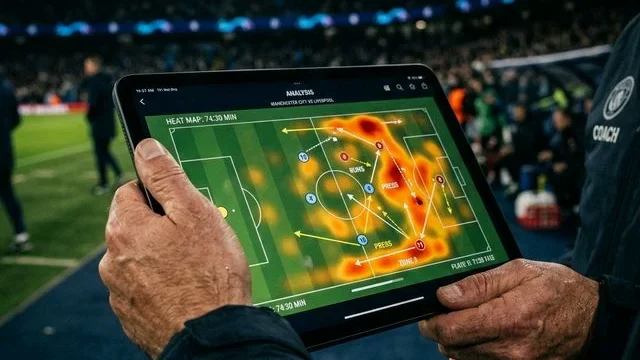
The day after a match, the squad gathers in the video analysis room. The manager will pause the footage to point out exactly where the team succeeded and where they failed. In this highly analytical environment, you must master the Third Conditional. This grammatical structure allows you to talk about hypothetical past situations—things that didn't happen, but *would have* changed the game if they did.
- Post-match (adj): Happening after the game has finished.
- Hindsight (noun): Understanding an event or situation only after it has happened. ("Hindsight is 20/20").
1. The Tactical Vocabulary: 8 Words for Analysis
Practice: drag a word, or select it and choose a gap.
1. Let's watch the slow-motion of that goal to see who lost their marker.
2. The goalkeeper made a massive by dropping the ball at the striker's feet.
3. Your was completely wrong; you were caught five yards too far forward.
4. The playmaker has incredible ; he saw that passing lane before anyone else did.
5. A top defender must where the cross is going to land and get there first.
6. Our strikers were not enough today; we had ten shots but zero goals.
7. We will only review the defensive clips today to fix our mistakes.
8. His in the final third was poor; he should have passed instead of shooting.
Choose a word, then choose a gap.
2. Essential Expressions for Video Review
Managers and pundits use these 6 expressions to critically evaluate a player's performance on the screen.
- "Read the game." Simplified: To understand the tactical flow of the match and predict what will happen next.
- "Caught out of position." Simplified: To be standing in the wrong place, leaving a gap for the opposition to exploit.
- "Cost us the match." Simplified: A specific mistake that was directly responsible for the team losing.
- "Put it on a plate." Simplified: To give a teammate such a perfect, easy pass that scoring the goal is practically guaranteed.
- "Should have done better." Simplified: A polite but firm way to criticize a player for missing a chance or making a mistake.
- "Ball-watching." Simplified: Staring at the ball instead of checking where the opposition attackers are moving.
3. Grammar Mechanics: The Third Conditional
To analyze a past mistake, we use the Third Conditional. It describes an unreal past condition (the "If" part) and its unreal past result (the "Would have" part). It essentially means: "Because X didn't happen, Y didn't happen."
| Structure | Usage | Analysis Example |
|---|---|---|
| If + Past Perfect (If he had passed...) |
The hypothetical action that did *not* actually happen in the past. | "If you had tracked back..." (But you didn't track back). |
| Would have + Past Participle (...we would have scored.) |
The hypothetical result that did *not* happen. | "...they would not have scored." (But they did score). |
| Full Sentence Example: "If the keeper had stayed on his line, he would have saved the penalty." | ||
Pro Tip: You can swap the order of the sentence without changing the meaning. (e.g., "We would have won if you had scored the penalty.") Notice there is no comma when "if" is in the middle!
4. Reading: The Video Session
Notice how the Manager uses the Third Conditional to point out alternative outcomes during the video review.
5. Interactive Practice: Rewriting History
Exercise A: Build the Third Conditional
1. "If the striker ___________ more clinical, we would have won the game 3-0."
2. "They wouldn't have scored the counter-attack if our full-back ___________ out of position."
Exercise B: Complete the Expressions
Type the missing words to complete these analytical phrases.
1. The pass was perfect; he basically put the goal on a for the striker.
2. You cannot get caught out of against a team with fast wingers.
6. Video Room Speaking Practice 🎙️
- Roleplay: You are the manager. Use the Third Conditional to explain to a player that if they had anticipated the pass, the team would not have conceded the goal.
- What does it mean if a player has great vision but is not very clinical?
- Explain the phrase "caught out of position". Why is this such a big blunder for a defender?
- Think of a famous real-life football match. Create a Third Conditional sentence about it (e.g., "If Baggio had scored the penalty...").