Facing the Microphones.
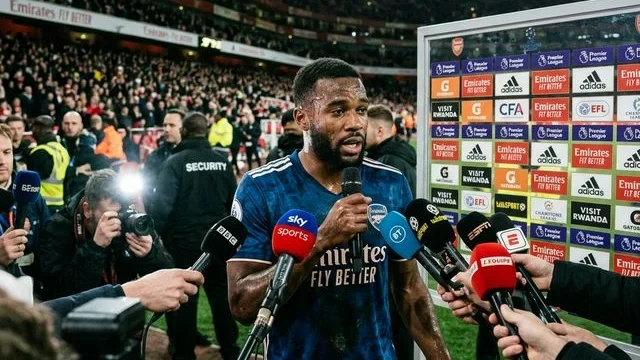
As soon as you walk off the pitch, the cameras are waiting. Journalists want controversy, but your job is to give them absolutely nothing. This is the art of the post-match interview. To survive the media zone safely, players use famous football "clichés" (boring, predictable phrases) and Reported Speech to talk about what the manager or referee *said*, without directly taking the blame.
- The Mixed Zone (noun): The area under the stadium where players must walk past journalists and answer questions after the match.
- Cliché (noun): A phrase or opinion that is overused and betrays a lack of original thought. In football, they are useful shields against the press!
1. The Media Vocabulary: 8 Press Words
Practice: drag a word, or select it and choose a gap.
1. The manager will speak to the media about the injuries in tomorrow's .
2. Don't believe everything you read; all these transfer rumors are just .
3. I scored a hat-trick on my debut! I am absolutely .
4. The tried to trick the captain into criticizing the referee.
5. He missed the penalty in the final minute, so obviously, he feels completely right now.
6. "Manager Loses The Plot!" was the main in all the Sunday papers.
7. The TV criticized our defense, but he hasn't played professional football in 20 years.
8. Be careful what you say, because they will you in tomorrow's paper.
Choose a word, then choose a gap.
2. Essential Expressions: The Football Clichés
If you don't want to cause a media scandal, give the press one of these 6 classic, boring football clichés. They say a lot while meaning very little.
- "At the end of the day..." Simplified: Ultimately... / The most important fact is... (Used before stating something obvious).
- "We gave 110%." Simplified: We tried our absolute hardest, even though it's mathematically impossible.
- "We're taking each game as it comes." Simplified: We are not looking at the league table or worrying about the future; we only focus on the next match.
- "It's a game of two halves." Simplified: Things can change very quickly. (Usually said when a team plays terribly in the first half but wins in the second).
- "We just need to focus on the positives." Simplified: We lost the game, but I don't want to talk about how badly we played.
- "The fans were our twelfth man." Simplified: The supporters were so loud that it felt like we had an extra player on the pitch.
3. Grammar Mechanics: Reported Speech
When you talk to the press, you often need to report what the referee or the manager said to you on the pitch. Because you are reporting words spoken in the past, the tenses usually take one step backwards in time. This is called "backshifting."
| Direct Speech (The original words) | Tense Change | Reported Speech (What you tell the press) |
|---|---|---|
| Manager: "We play well." | Present Simple ➡️ Past Simple | "The manager said that we played well." |
| Referee: "I saw a foul." | Past Simple ➡️ Past Perfect | "The ref claimed that he had seen a foul." |
| Pundit: "They will lose." | Will ➡️ Would | "The pundit predicted that we would lose." |
Pro Tip: The word "that" is optional! "He said he was injured" is the same as "He said that he was injured."
4. Reading: The PR Briefing
Notice how the Club Press Officer helps the Player convert his angry thoughts into safe reported speech and clichés before he faces the media.
5. Interactive Practice: Managing the Media
Exercise A: Backshift the Tense
1. The referee originally said: "It is a clear penalty." How do you report this to the press?
2. The manager originally said: "I didn't see the incident." How do you report this?
Exercise B: Complete the Clichés
Type the missing words to complete these classic football clichés.
1. At the of the day, the only thing that matters is the three points.
2. We aren't worried about winning the league yet; we are just taking each game as it .
6. Media Zone Speaking Practice 🎙️
- Roleplay: You are speaking to a TV pundit after losing a game 4-0. Use the cliché "focus on the positives" and explain how you feel using the word "gutted".
- Why do players use clichés like "we gave 110%" instead of telling journalists what they actually think?
- Convert this direct quote into Reported Speech: The captain shouted, "We will win this game!" -> "The captain shouted that..."
- What does it mean if a player says "the fans were our twelfth man"?