
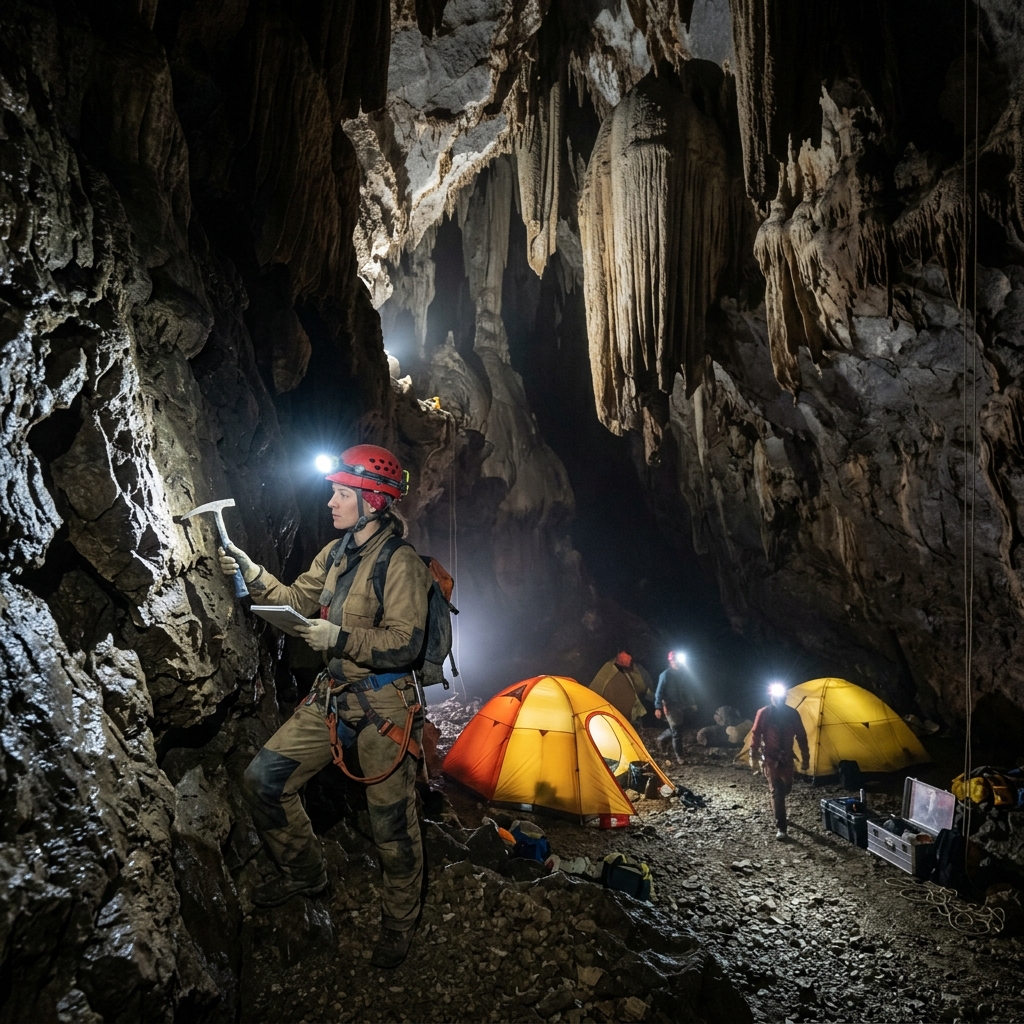
An international team of scientists has successfully completed a challenging thirty-day mission inside the Veryovkina Cave, the deepest known cave on the planet. The expedition descended to a depth of over two thousand metres below the surface, where they lived in complete darkness. The goal of the research was to study how extreme sensory deprivation affects the human body and mind over an extended period. With only headlamps to guide them, the team had to adapt to a silent world completely isolated from the modern environment.
Living inside the cave presented several formidable challenges, including constant humidity, near-freezing temperatures, and the psychological impact of absolute isolation. The team pitched their high-tech tents on a narrow rocky ledge, surrounded by a black, seemingly bottomless abyss. "The silence is the most striking thing; it has a very eerie quality that makes you hear things that aren't there," explained the lead researcher, describing the strange auditory tricks of the deep subterranean chamber. The team had to monitor their physical health closely to prevent hypothermia.
"At first, the lack of sun completely destroyed our sense of time, making it incredibly disorientating to plan our daily tasks," stated geologist Dr. Mikhailov, speaking from the base camp. "Without the transition of day and night, we had to rely on alarms to tell us when to sleep and eat. It was a true test of human endurance. However, the scientific rewards are immense; we collected soil samples that could contain completely unknown microorganisms."
The cave's confined spaces triggered minor bouts of claustrophobia among some team members, who had to practice breathing exercises to stay calm. The researchers had to cope with the absolute monotony of the dark landscape, where every day felt identical. Despite these issues, the scientists demonstrated incredible adaptability, maintaining their work schedule without conflict. "It was highly disorientating when we first climbed back to the surface and saw sunlight again," said one biologist, who described the blinding return to the light. The experience tested their physical and mental endurance to the limit.
In the end, the expedition successfully returned to the surface with valuable data on how human biological equilibrium reacts to extreme isolation. The scientific community has praised the team's bravery, noting that the study will help prepare astronauts for long-duration missions to Mars. The dark depths of Veryovkina Cave remain a silent monument to the earth's secrets, but for this brave team, the underworld is no longer a place of fear, but a source of scientific discovery that will inspire future explorers for generations.
💬 Reader Comments
Loading comments...